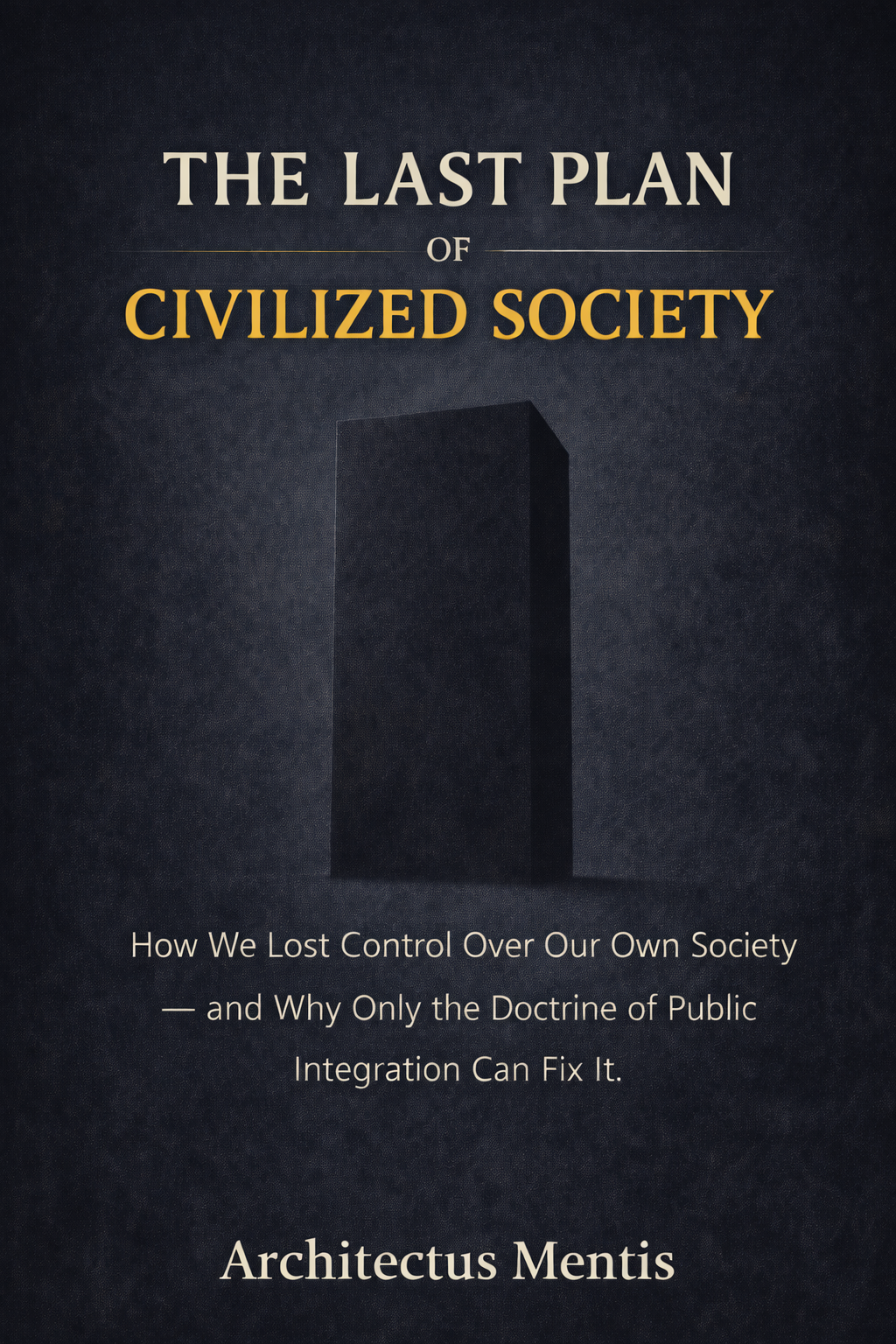
THE LAST PLAN OF CIVILIZED SOCIETY
How We Lost Control Over Our Own Society — and Why Only the Doctrine of Public Integration Can Fix It
The book is available for purchase in multiple languages: English, French, German, Italian, and Spanish.
About the Book
This book is not about migration, nor is it about politics in the conventional sense.
It addresses a deeper issue: why modern societies have lost a clear understanding of the rules by which they function.
Today we constantly hear about values, rights, tolerance, and humanism. Yet the most important elements are avoided — clear definitions, boundaries of responsibility, and transparent rules. As a result, public discourse is replaced by emotion, governance by simulation, and the law by interpretation.
The current crisis is not a crisis of people or cultures.
It is a crisis of governance and structure.
This book is dedicated to that problem.
What This Book Is About
The book presents, in a clear and accessible manner, the Doctrine of Public Integration — a systemic approach to organizing complex, multi-layered societies in conditions of migration, cultural diversity, and weakening state institutions.
It does not offer slogans, moral judgments, or political preferences. Instead, it:
explains why existing integration models fail;
shows how the substitution of concepts undermines trust between society and the state;
clearly separates humanism from irresponsibility, and compassion from managerial weakness;
defines where rights end and obligations begin;
proposes a universal framework applicable across different countries and legal systems.
This is not a collection of opinions.
It is an attempt to restore rational thinking where emotion currently dominates.
Why This Book Matters Now
Modern societies increasingly face a paradox:
the more freedom and equality are proclaimed, the less clarity and trust remain.
When rules are blurred, society ceases to function as a system and becomes a field of conflict, where success belongs not to those who are right, but to those who are louder. In such conditions, the state loses its capacity to govern, and citizens lose their understanding of what is expected of them.
This book raises uncomfortable questions:
can a society exist without clear norms;
is freedom possible without responsibility;
where does the line lie between integration and the disintegration of social structure.
Most importantly, it explores what alternatives remain once populism and simplification are set aside.
What You Will Gain from This Book
By reading this book, you will gain:
a clear understanding of the systemic causes behind the contemporary social crisis;
structured explanations of key concepts, free from ideological noise;
an analytical framework applicable to any complex society;
a tool for distinguishing real governance from the imitation of governance;
a text written for mature, thinking readers — not for mass consumption.
This book does not provide ready-made political solutions.
It helps you understand how solutions become possible at all.
Who This Book Is For
This book is not for everyone.
It is intended for those who:
sense that something fundamentally is wrong with modern social models;
are tired of media clichés and political spectacle;
prefer structure over emotion and analysis over slogans;
understand order as a condition of freedom, not its enemy.
If you are looking for simple answers, this book will disappoint you.
If you are seeking clarity and coherence, it is essential.
The Book and the Doctrine
This book serves as an explanatory key to the Doctrine of Public Integration.
The book presents the ideas of the Doctrine in clear, human language, outlining their logic, premises, and consequences.
The Doctrine itself formalizes these ideas into a structured policy framework.
For this reason, it is strongly recommended to begin with the book.
Conclusion
The modern world does not suffer from a lack of compassion.
It suffers from a lack of structure, responsibility, and clarity.
If you want to understand what a society can look like when humanism does not contradict the rule of law, start with this book.